
On this page
No time to read? Listen to a conversation about this blog post instead.
There are three spots in Google’s local Map Pack.
Just three. For every attorney search with a geographic component, “personal injury attorney near me,” “divorce lawyer in Atlanta,” “criminal defense attorney Charlotte”, Google shows three firms prominently at the top of the local results, above organic listings, with their rating, review count, location, and a direct call button.
Those three spots capture a significant share of the clicks on the page. And for most law firm searches, they’re contested by dozens or hundreds of competing firms.
Most law firms are not in those three spots. Many haven’t seriously tried to get there.
That’s the play most attorneys are missing.
Why the Map Pack Matters More Than Most Attorneys Realize
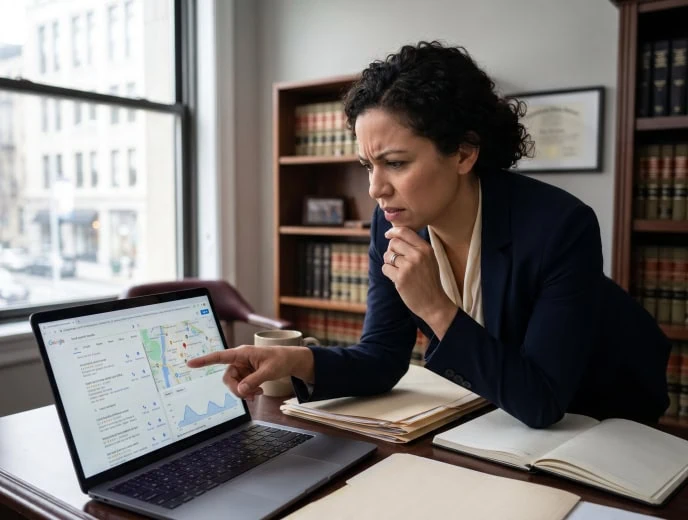
When someone searches for an attorney on a mobile device, which is how the majority of legal searches happen, the Map Pack dominates the screen. The AI Overview appears, then the Map Pack fills most of what’s visible. Organic results require scrolling.
On desktop, the Map Pack appears above organic results for local intent searches. The visual weight of a firm appearing in the Map Pack, with star ratings, review count, address, and hours, exceeds what a text-only organic listing conveys.
The Map Pack is also the entry point for a significant behavior: many legal clients call directly from the Map listing without visiting the firm’s website at all. The call button is right there. They’ve seen the rating, checked the review count, confirmed the location, that’s enough to call.
A firm that ranks number one organically but is absent from the Map Pack is invisible to a meaningful portion of the people searching for them. The Map Pack and organic rankings aren’t interchangeable. They serve different searcher behaviors and compete for different kinds of attention.
What Drives Map Pack Rankings
The factors that determine which three firms appear in the Map Pack are different from the factors that drive organic rankings, though they overlap.
Google Business Profile completeness. The GBP is the foundation of local SEO. A complete profile, accurate name, address, phone, website, hours, practice area categories, photos, services, signals to Google that the firm is a legitimate, active local business. An incomplete or neglected profile is a significant competitive disadvantage.
Practice area categories matter more than most attorneys realize. Selecting the right primary and secondary categories, “personal injury attorney” rather than just “law firm”, tells Google which searches the firm should appear for. Selecting the wrong categories, or too few, limits local visibility.
Review volume and velocity. Google weights review signals in Map Pack rankings. A firm with 200 recent reviews at 4.9 stars sends a stronger local authority signal than a firm with 15 reviews from two years ago. Review velocity, getting new reviews consistently rather than in occasional bursts, signals an active, ongoing business rather than a stagnant one.
Most law firms don’t have a systematic review generation process. They get reviews when a particularly satisfied client thinks to leave one. That’s why most firm review counts are low relative to the opportunity. A simple follow-up system, a text or email to every client after matter close, with a direct link to the GBP review page, converts a fraction of satisfied clients into reviewers consistently.
Local citation consistency. Google cross-references the firm’s name, address, and phone number across directories, Avvo, Martindale, FindLaw, Yelp, the state bar directory, local business directories. Inconsistencies in how the firm is listed (different phone numbers, address variations, name differences) create confusion in Google’s local authority evaluation. Consistent citations across all platforms reinforce local authority signals.
Location proximity. Google factors proximity to the searcher in local results. A firm physically located in the center of a city will rank more easily for citywide searches than a firm at the outskirts. This is a fixed factor attorneys can’t change, but it underscores why firms in specific neighborhoods should focus their local SEO on hyper-local searches rather than competing citywide.
Website authority signals. The firm’s website, its content quality, backlink profile, technical health, influences Map Pack rankings as well as organic rankings. Local SEO and traditional SEO aren’t separate disciplines. A weak website undermines Map Pack performance even when the GBP is optimized.
GBP engagement signals. Google tracks how users interact with GBP listings: clicks to call, direction requests, website clicks, photo views, Q&A engagement. Active profiles that generate consistent engagement rank better than static ones. Regular posts, updated photos, answered questions, and prompt responses to reviews all contribute to this engagement signal.

The Review Problem in Detail
Review volume is the single biggest gap between the firms dominating the Map Pack and the firms that aren’t in it.
The top law firms in competitive markets average over 200 Google reviews. Many law firms have fewer than 20. That’s not a quality gap, many of those firms serve their clients as well or better than the larger firms outranking them. It’s a systems gap. The larger firms have review generation processes. The smaller firms ask occasionally and hope.
Building review volume requires nothing more complicated than asking consistently and making it easy. A follow-up text to every client after their matter closes, with a direct link to the Google review page, converts a meaningful percentage of satisfied clients into reviewers. Over 12 months of consistent execution, a firm can move from 18 reviews to 120. That’s a different Map Pack signal. That’s a different recommendation in AI search. That’s a different firm.

Map Pack and AI Search: The Same Signals
One of the most important things to understand about local SEO in the current landscape is that the signals driving Map Pack rankings are the same signals that feed local AI search recommendations.
When someone asks ChatGPT or Perplexity for an attorney recommendation in a specific city, those AI tools pull heavily from local search signals, GBP data, review volume, citation consistency, the same infrastructure that drives Map Pack performance. A firm that has invested seriously in local SEO isn’t just competing for Map Pack placement. It’s building the foundation for AI search visibility simultaneously.
The firms appearing in AI-generated attorney recommendations in local markets are almost always the firms that have done serious local SEO work. Not always, content depth and cross-platform authority matter too, but the local signal infrastructure is a significant input.
Investing in local SEO and Map Pack optimization is investing in two things at once.
Forward Push manages local SEO, Google Business Profile optimization, and review generation as integrated components of the Case Gravity system.