
On this page
TL;DR Criminal defense clients make hiring decisions fast, under pressure, and from a place of fear. This article explains the urgency-based marketing approach, trust signals, and response strategy that win those cases first.
No time to read? Listen to a conversation about this blog post instead.
If your law firm runs Local Services Ads, a significant change went into effect on October 20, 2025 and most managing partners missed the strategic implications buried in Google’s “badge refresh” announcement.
Analysis of Google’s October 20 update reveals this wasn’t a branding change. It’s an algorithmic restructuring that makes operational excellence the only competitive advantage. The “Google Screened” badge has been replaced with a generic “Google Verified” checkmark that every LSA participant now displays. The badge became table stakes. Your ranking, and therefore your lead volume, now depends entirely on response speed, lead acceptance rates, and review accumulation.
Here’s what the data reveals: Google’s algorithm now weights response time above all other factors. Firms with immediate response capabilities see higher rankings. Firms maintaining high lead acceptance rates get priority placement. Firms systematically collecting verified job reviews from LSA clients see sustained visibility. The badge won’t differentiate you. Your intake operations will.
Below is what changed on October 20, why it matters, and exactly what your law firm needs to do now to adapt and stay competitive.
Understanding the Badge Change
What’s Changing on October 20, 2025
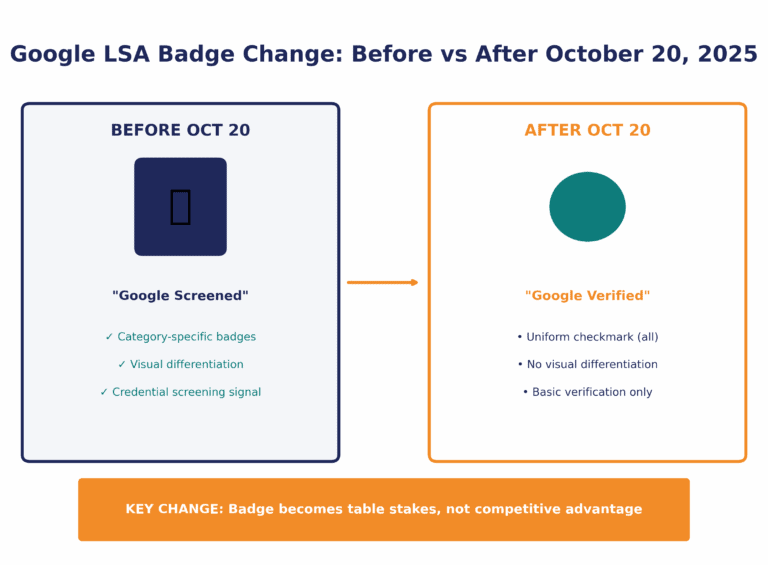
Old System (Before Oct 20) vs New System (After Oct 20)
What the Verified Badge Actually Means
The verified badge signals you’ve passed Google’s vetting process; license verification, insurance confirmation, and background checks. That’s it. It’s a credential check, not a consumer protection plan. Requirements to maintain the badge haven’t changed (current state bar licenses, malpractice insurance, clean background checks). What changed is the consumer-facing promise: “vetted” is not “guaranteed.”
The strategic reality: The verified badge is now table stakes, the cover charge to play, not a competitive advantage. Every LSA participant in your practice area will have the same blue checkmark. It won’t differentiate you, and it won’t drive performance. Your operations will.
What’s Different for Law Firms Specifically
1. Expanded practice area support: LSAs now support immigration law, family law, and estate planning in addition to the original categories (personal injury and criminal defense). If your firm practices in these areas, LSA visibility is now available.
2. Badge parity across all categories: Every LSA participant displays the same blue checkmark. Visual differentiation is eliminated. The badge becomes table stakes rather than competitive advantage.
The Strategy Behind the Change
Why Google Is Making This Change
Google’s stated reason: simplifying the consumer experience. One badge, one standard, less confusion.
Analysis of the timing reveals the strategic reality: the Local Services Ads program is 10 years old and has reached market maturity. Standardizing badges reduces Google’s operational complexity while maintaining the perceived trust signal that drives ad revenue. The badge looks official. Consumers still see “verified.” But the differentiation that previously existed between service categories is eliminated.
Strategic implication for law firms: Industry analysis suggests Google may be moving toward a model where LSA participation becomes necessary for competitive local visibility. The pattern follows Google Shopping’s evolution—paid placements eventually displaced organic listings. If that trajectory holds, non-participation in LSAs risks reduced visibility even in organic Google Business Profile results.
Why This Matters for Law Firm Visibility
The verified badge no longer differentiates you from competitors. Everyone in your practice area who participates in LSAs displays the same blue checkmark. Visual uniformity removes any badge-based edge.
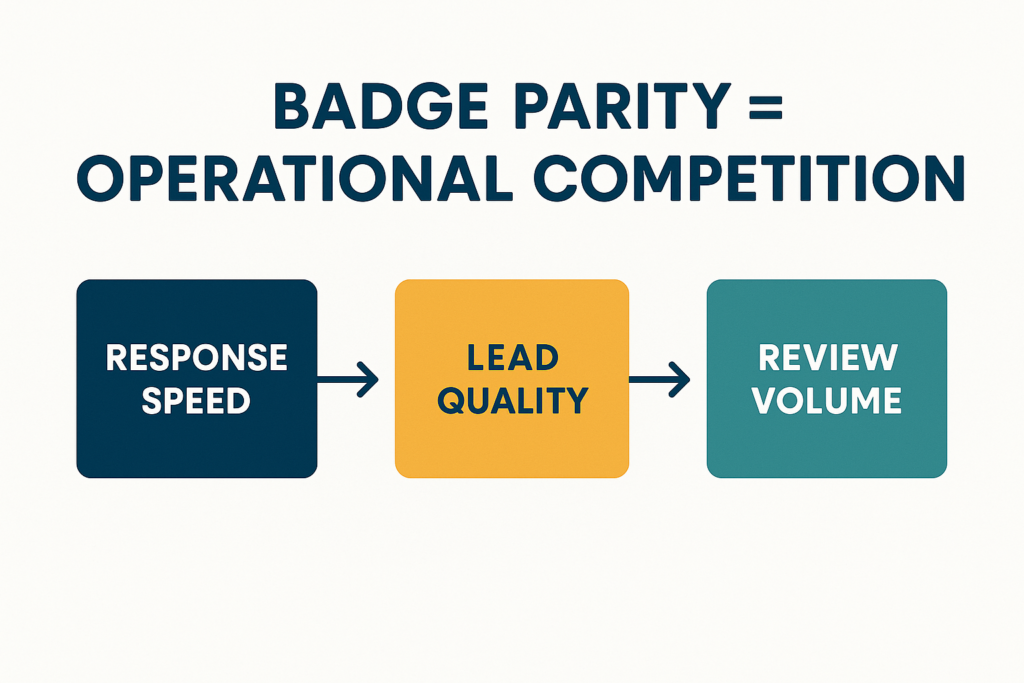
The strategic shift this reveals: Badge parity forces operational competition. The algorithm now prioritizes behavioral metrics over static credentials. Analysis of Google’s October update reveals four competitive implications:
1. Operations determine ranking: Response speed, lead acceptance rate, review volume, and profile accuracy are now primary ranking factors. The firms with the best intake systems win LSA placements.
2. Budget becomes visibility requirement: Competitive legal markets require monthly LSA budgets between $1,000 and $5,000. This data comes from Omnizant’s analysis of LSA economics across practice areas.
3. Review thresholds rise: Minimum credibility threshold is 20+ Google reviews before launching LSAs. But verified job reviews from LSA bookings now carry more algorithmic weight than general GBP reviews.
4. Non-participation risk increases: If LSA placements eventually displace organic GBP results (following Google Shopping’s pattern), non-participation risks reduced visibility even in unpaid listings.
Why Operational Excellence Now Determines Success
The badge won’t drive your LSA performance. Your operations will.
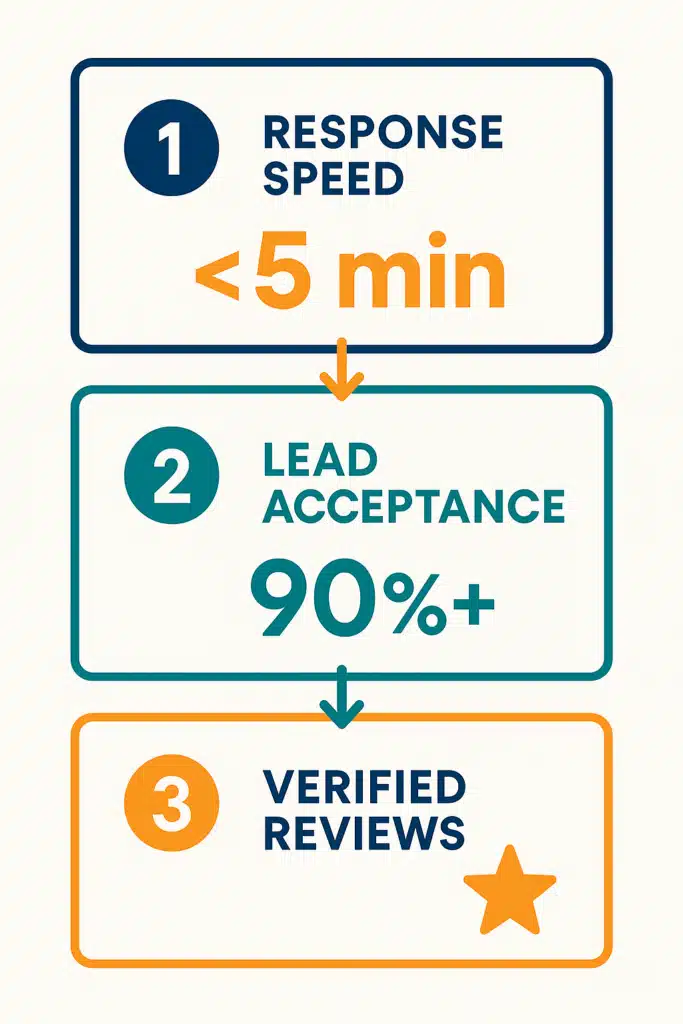
Google’s October 2025 update includes algorithmic changes that make operational metrics the primary ranking factors:
1. Response speed (primary ranking factor): How quickly you accept or decline incoming leads now carries more weight than any other factor. Google measures time to respond, lead acceptance rate, and consistency during stated business hours. Slow response = lower ranking = fewer leads. This requires a dedicated intake person monitoring LSA leads in real-time.
2. Lead quality feedback loop: Marking leads as valid or invalid trains Google’s algorithm. When you dispute a lead as spam, geo mismatch, job type mismatch, or solicitation, Google adjusts what it sends you. Critical insight: lead credits are NOT fully automated. Marking lead quality often triggers instant credit application, but if you don’t mark leads, you may pay for junk without recourse.
3. Review and profile integration: Verified job reviews (from clients booked through LSAs) now carry more weight than general Google Business Profile reviews. Review response rate is being tested as a minor ranking signal. Your GBP data directly feeds LSA ranking—profile accuracy is non-negotiable. If your GBP gets suspended, your LSA ads pause.
The reality check: LSAs work, but they demand operational maturity and dedicated resources. As Omnizant puts it: “The platform demands active management rather than passive setup.” You can’t launch LSAs, set a budget, and forget about it. The algorithm rewards firms that actively manage lead quality, respond instantly, and systematically request verified reviews from booked clients.
The New LSA Playbook
How the New Ranking Factors Work
Responsiveness Weight Increase
Response speed is now the primary ranking factor. Google measures three things:
– Time to respond: How quickly you accept or decline a lead after it comes in. Target: immediate (within minutes). The LSA dashboard tracks this metric and directly affects your ranking.
– Lead acceptance rate: Percentage of leads you accept vs. decline. High acceptance rates signal to Google that you’re receiving quality leads and maintaining proper availability.
– Consistency during business hours: If you list your firm as available Monday-Friday 9am-5pm, Google expects you to respond to leads during those hours.
Why this matters: Slow response doesn’t just lose you individual leads—it lowers your ranking, which reduces the volume of future leads you receive. This creates a negative feedback loop.
Operational requirement: You need a dedicated person monitoring LSA leads in real-time. The algorithm is measuring response time in minutes, not hours.
Lead Quality Feedback Loop
Google’s algorithm learns from your feedback. When you mark a lead as invalid, Google adjusts its targeting. Dispute categories available: spam, geographic mismatch, job type mismatch, solicitation.
Critical operational insight: Lead credits often apply instantly when you mark lead quality, but the process isn’t fully automated. If you don’t mark invalid leads, you may never receive credit, and you’re training the algorithm to send you more junk.
Best practice: Dispute invalid leads aggressively, with proper categorization. This protects your budget and ensures you’re not paying for leads you can’t convert.
Review and Profile Integration
Google Business Profile data now directly feeds Local Services Ads ranking:
– Verified job reviews: Reviews from clients booked through LSAs carry more weight than general GBP reviews.
– Review response rate: Google is testing review response rate as a minor ranking signal.
– GBP profile completeness: Your business hours, service areas, practice area listings, phone number, and profile photos must be 100% accurate. If your GBP gets suspended for any reason, your LSA ads pause immediately.
How the New Bidding Options Work
“Maximize Leads” (Classic Strategy)
How it works: You set a weekly budget, and Google maximizes the volume of leads you receive within that budget.
Best for: Firms wanting predictable weekly spend, high-volume practice areas where cost per lead is relatively stable, smaller firms that need to control total marketing spend tightly.
Limitation: You have less control over cost per individual lead.
“Max Per Lead” (New Strategy)
How it works: You set the maximum amount you’re willing to pay for a single lead. Google shows your ads whenever the cost per lead falls at or below your maximum. If the cost exceeds your max, Google skips that impression.
Best for: High-value practice areas (personal injury, complex family law, estate planning cases with large retainers), time-sensitive consultations where being first to respond justifies premium cost, firms with strong lead lifetime value data.
Strategic advantage: You can bid aggressively for leads during peak moments. Example: A personal injury firm knows that accident-related searches spike on weekday evenings and weekends. They set a “Max Per Lead” of $150 during those hours, signaling willingness to pay a premium for immediate visibility when high-value leads are searching.
Key insight: Legal services have high lead lifetime values. A single personal injury case can generate $10,000+ in fees. A contested family law case can generate $5,000-$15,000. If your average case value is $8,000 and your close rate on valid leads is 20%, each lead is worth $1,600 in expected revenue. Paying $100-$150 per lead becomes profitable, but only if you have the operational maturity to respond instantly and convert efficiently.
How to Optimize Your LSA Profile
AI & Voice Search Considerations
LSAs are now prominent in Google Maps, Google Assistant voice searches (“Hey Google, find a lawyer near me”), and AI Overviews. This creates new operational requirements:
– Business hours must be perfect: Voice and AI queries rely on structured data. If your hours are wrong, Google Assistant won’t show your firm when someone searches during your actual availability.
– Services offered must be specific: AI systems parse your practice area listings literally. “Family law” is vague. “Child custody disputes” and “divorce mediation” are specific.
– Profile accuracy is non-negotiable: There’s no room for outdated information. A disconnected phone number or incorrect address kills your voice search presence.
Action Plan for Law Firms
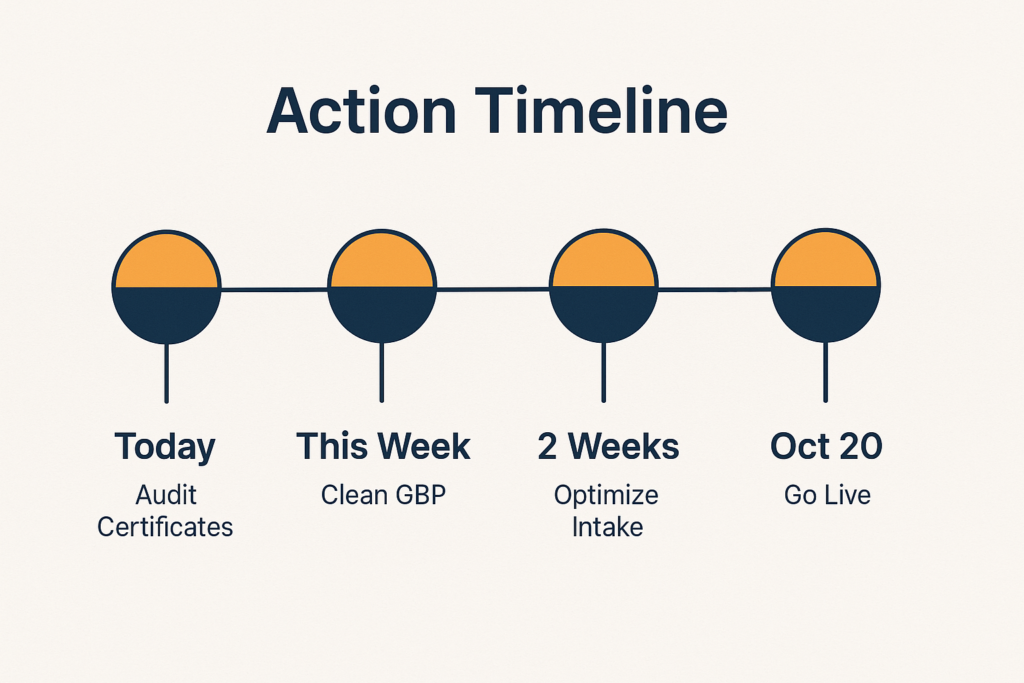
Action Steps to Adapt Now (Post-October 20)
Ongoing Optimization Checklist
Weekly Tasks (30 minutes Monday morning)
– Review all leads from previous week: mark as booked, archived, or disputed
– Dispute invalid leads immediately with proper categorization
– Check responsiveness score in LSA dashboard (improving or declining?)
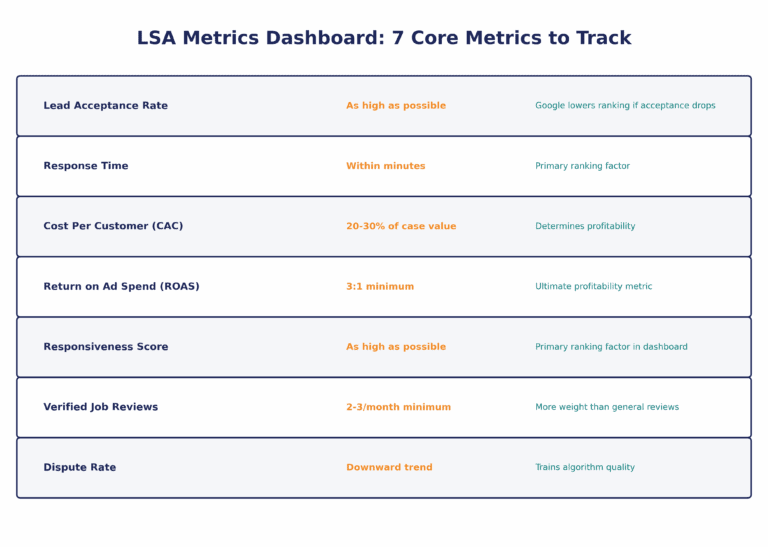
– Monitor lead acceptance rate (maintain as high as possible)
– Request verified job reviews from all clients booked through LSAs this week
Monthly Tasks (1 hour, first Monday of month)
– Audit bidding strategy performance: Are you getting consistent volume/ROI?
– Calculate cost per acquired customer (CAC): Total LSA spend / Total clients booked
– Calculate return on ad spend (ROAS): Revenue from LSA clients / LSA spend (target: 3:1 minimum)
– Update service area or practice area listings if your business changed
– Check for new “Verified Expertise” badge opportunities in LSA dashboard
Quarterly Tasks (2-3 hours, first week of quarter)
– Comprehensive GBP audit (update photos, post case results, answer Q&A, verify attributes)
– Competitive analysis: Search your practice areas + city, note which competitors rank above you, review their profiles
– Budget reallocation: Calculate ROAS by practice area, shift budget toward areas with best ROAS, consider pausing areas with ROAS below 2:1
– Review and update intake workflows: Are response times improving? What percentage of valid leads convert?
– Training refresh for LSA lead management team: Review dispute categories, reinforce response time targets, share wins
Metrics to Track (The Dashboard You Need)
The Badge Is Just the Beginning
The October 20 badge change is cosmetic. The verified checkmark won’t differentiate your firm, and it won’t improve your lead volume. What matters is what’s happening under the hood: Google’s algorithm now prioritizes responsiveness, lead quality management, and review accumulation above all other factors.
The real change is operational. Law firms that win on LSAs after this update will be the ones with the best systems—dedicated intake managers monitoring leads in real-time, weekly lead dispositioning processes, systematic review requests from every booked client, and bidding strategies aligned with practice area economics.
LSAs remain a valuable tactic for law firms: rapid lead generation, pay-per-lead pricing, and immediate visibility in competitive markets. But they’re not a complete strategy. Forward Push’s point of view: build owned marketing channels, SEO, content marketing, email, alongside LSAs. Don’t become over-reliant on any single Google channel. The verified badge change is proof that Google will adjust rules to protect its revenue. Smart firms prepare for the next change by diversifying lead sources.
Your action plan this week:
1. Audit certificates (licenses, insurance, background checks) and renew anything expiring within 60 days
2. Deep clean your Google Business Profile—verify hours, service areas, phone number, practice area listings
3. Assign a dedicated LSA lead manager with real-time monitoring capability
4. Implement weekly lead dispositioning (mark booked, archived, disputed)
5. Start tracking the 7 core metrics: responsiveness score, lead acceptance rate, CAC, ROAS, response time, verified job reviews, dispute rate
The law firms that win on LSAs after October 20 won’t be the ones with the best badge, they’ll be the ones with the best systems. Build those systems now.