By Marc Apple ● ● 7 min read

Table of Contents
TL:DR The traditional attorney video model fails not because of discipline but because it's structurally broken, it puts the attorney in the role of production bottleneck, and AI-era video systems solve that by separating content creation from attorney scheduling.
You know you need video.
Every attorney at the $500K level knows this. They’ve read the statistics. They’ve watched competitors build YouTube channels and Instagram presences and show up on the website with a face and a voice that makes prospective clients feel like they already know who they’re hiring. They know what video does, and they know they’re not doing it consistently.
Here’s why.
It’s not a discipline problem. It’s a structural problem. And the agencies and consultants who keep telling attorneys to “just start recording” have never run a law firm.
Why Attorney Video Always Collapses
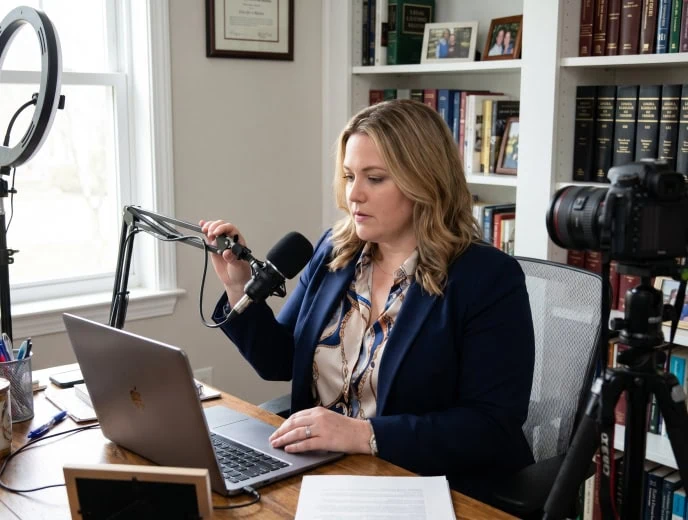
The standard model for attorney video marketing goes like this. The attorney schedules a recording session, usually a half-day at a studio or with a videographer. They prepare topics. They show up. They record. The agency edits. Content gets published.
Then the next session gets scheduled.
And cancelled. Because a deposition ran long. Because a client needed an urgent call. Because trial prep absorbed the week. Because the calendar just doesn’t have a half-day available until next month, and by then three other things have taken priority, and the video content that was supposed to go out every two weeks has been sitting at zero for four months.
This isn’t weakness. This is how law firms actually operate. Attorneys bill time, carry cases, and absorb other people’s crises. A marketing strategy that requires them to periodically stop practicing law and sit in front of a camera is a strategy that will fail, not immediately, but reliably, over and over, every time the case load gets heavy.
The result is the attorney who has one polished intro video from 2021 on their homepage and nothing else. Who has a YouTube channel with three videos and no uploads in 18 months. Who keeps meaning to get back to it.
What Video Actually Does That Nothing Else Can
Before explaining what replaces the old model, it’s worth being precise about why video matters in the first place. Because the answer isn’t “because everyone says so.”
There is a specific kind of trust that only builds through repeated exposure to someone’s face and voice. A bio page doesn’t create it. Five-star reviews don’t create it. A well-written practice area page doesn’t create it.
Watching someone explain something in their own words, hearing how they think through a problem, seeing how they carry themselves, noticing whether they speak with confidence or hesitation, that creates familiarity. And familiarity, in a high-stakes decision like hiring an attorney, is what moves a prospect from “still looking around” to “calling this firm.”
The decision journey for most legal clients today includes multiple touchpoints before a call is made. They search. They read. They compare. And increasingly, they watch. A prospect who has watched 15 minutes of an attorney explaining their practice area before calling arrives at a fundamentally different kind of conversation than one who found a name in a directory. They feel like they already know the attorney. They’ve already formed a level of trust that normally takes an in-person meeting to establish.
Research consistently supports what practitioners already intuit: video increases confidence in a brand for the majority of viewers. Embedded video lifts website traffic and time-on-site. Video content on YouTube and social platforms compounds over time, older videos keep driving views and trust-building long after they’re published.
The attorneys who figure this out and publish consistently become the obvious choice in their market. The attorneys who know they need to do it but can’t sustain the production schedule stay invisible in video while their competitors fill the space.
What Changed in 2025
The reason the old model is now definitively broken, rather than just difficult, is what happened to AI video technology in 2025.
The quality threshold for AI-generated video crossed into professional territory. Voice cloning that doesn’t sound robotic. Avatar rendering that doesn’t look uncanny. The ability to take a single recording session and produce from it an ongoing stream of content that is visually and audibly indistinguishable from the attorney sitting in front of a camera that day.
This changed what’s possible.
An attorney no longer has to choose between consistent video presence and running their practice. They record once, a single capture session, and the system produces ongoing content from that capture. New topics. New scripts. New formats. The attorney’s face, the attorney’s voice, the attorney’s cadence. Distributed across YouTube, the website, social media, and retargeting campaigns on an ongoing schedule.
The recording session doesn’t get cancelled. It already happened. The content keeps coming.
This is what Counsel Twin AI is. Not a gimmick. Not a workaround. A fundamental change to the architecture of attorney video marketing.
How Counsel Twin AI Works
The process starts with one capture session. The attorney sits down, once, and Forward Push records them. Face, voice, the way they speak when they’re explaining something they know well. Not a generic video shoot. A precision capture designed to build two assets: a video avatar that looks and moves like the attorney, and a voice model that sounds like them.
That session is the last time the attorney needs to be in front of a camera.
Before any content is produced, the content strategy is built. Practice-area-specific SEO research. Real questions pulled from search behavior and intake patterns, the things ideal clients are actually asking. Conversion-focused scripts. Positioning that reflects the attorney’s specific expertise, not a template written for attorneys in general.
The content strategy comes first. Everything else executes against it.
From there, the system produces continuously. Video content, audio content, short-form social clips. The attorney’s face. The attorney’s voice. Distributed across YouTube, the website, social platforms, and retargeting campaigns. Content that would have required monthly studio sessions and consistent scheduling now runs without requiring the attorney’s ongoing time.
The result is a video presence that compounds. A prospect who found the firm through organic search sees a video on the practice area page. Finds more on YouTube. Sees a short clip in their social feed. Hears the attorney’s voice explaining their specific situation. By the time they call, they’ve spent 20 minutes with the attorney without a single meeting. That’s not a small advantage. That’s a compressed sales cycle and a more confident client relationship from the first real conversation.

The Production Standard
The quality of Counsel Twin AI content is not the quality of a generic AI video tool. It’s not a stock avatar with a synthesized voice reading from a script.
Forward Push produced the television commercial for Buckley Law Offices that aired during the Super Bowl. That is the production standard and strategic discipline that informs how every Counsel Twin AI implementation is built. The same team that executes at broadcast level writes the scripts, builds the avatars, manages the distribution. Not a content mill. Not a template handed to a junior employee.
Every implementation is built for the specific firm. A personal injury firm’s video content addresses the fears and questions of personal injury clients, not generic legal content. A family law practice’s content speaks to the emotional reality of the clients it serves. The practice area shapes the content strategy. The content strategy shapes every piece of content that comes out of the system.
What Keeps Running When You’re in Court
Here’s the practical picture.
On a Tuesday when the attorney is in trial, Counsel Twin AI publishes a new video to YouTube explaining what happens after a car accident in their state. That video was scripted by the Forward Push content team, reviewed and approved, and scheduled, without the attorney being involved after the initial capture session.
A prospect searching YouTube for answers to that exact question finds the video. Watches it. Finds the firm’s website. Watches the practice area video on the homepage. Reads the content. Has a question answered by Sidebar AI. Decides this firm is the obvious choice. Calls Monday morning.
The attorney didn’t record anything. They didn’t post anything. They didn’t schedule anything. The system ran while they were in court.
That’s the compounding effect of consistent video presence done correctly. Every piece of content adds to a library that keeps working. Every video builds familiarity with the firm’s name and face. Every month the system runs, the trust advantage over a competitor who isn’t publishing video grows larger.
Video and AI Search
Video content today is not just a trust-building tool. It’s an AI search signal.
Google’s AI Overviews and third-party AI tools like ChatGPT and Perplexity evaluate entity authority when deciding who to recommend. An attorney with a substantial YouTube presence, dozens of videos with views, engagement, and watch time, signals authority to these systems in ways that text content alone doesn’t. A firm that appears consistently on video across YouTube, their website, and social platforms is harder for AI tools to overlook than a firm that exists only as text.
The attorneys showing up in AI-generated attorney recommendations today built multi-format presences, text, video, audio, across platforms. Counsel Twin AI is what makes that achievable without requiring the attorney to do the work of a content creator.

The Attorney Who Almost Did This
The most common version of the Counsel Twin AI conversation goes like this.
The attorney has been meaning to do video for two years. They know it would help. They’ve cancelled two recording sessions. They’re embarrassed about it. They’ve convinced themselves that maybe video isn’t right for their practice area, or their age, or their personality.
None of that is true. Video works across practice areas, demographics, and personality types. The only variable is whether the attorney has a system that produces content without depending on their ongoing availability to produce it.
That’s what the capture session solves. One afternoon. Everything after that runs.
Counsel Twin AI is the content engine inside Case Gravity, Forward Push’s integrated system for law firm market dominance. See how it works.


